AI Agents
What Agentic AI Actually Means in 2026 (and What It Doesn't)
By Niall · 7 min read
Agentic is the word of the year and the most overused; here is what it really means and when you actually need an agent.
Agentic is the word of the year, which means it is also one of the most overused. It gets stuck on everything from a basic chatbot to a glorified if-statement. Underneath the marketing, though, there is a real and useful distinction, and understanding it helps you tell the difference between a problem that genuinely needs an agent and one that a simpler tool would serve better.
In 2026 the shift everyone is describing is the move from AI that assists a person, suggesting, drafting, answering, to AI that acts more autonomously on its own. That shift is real. It is also frequently misapplied, which is its own kind of risk.
What agentic actually means
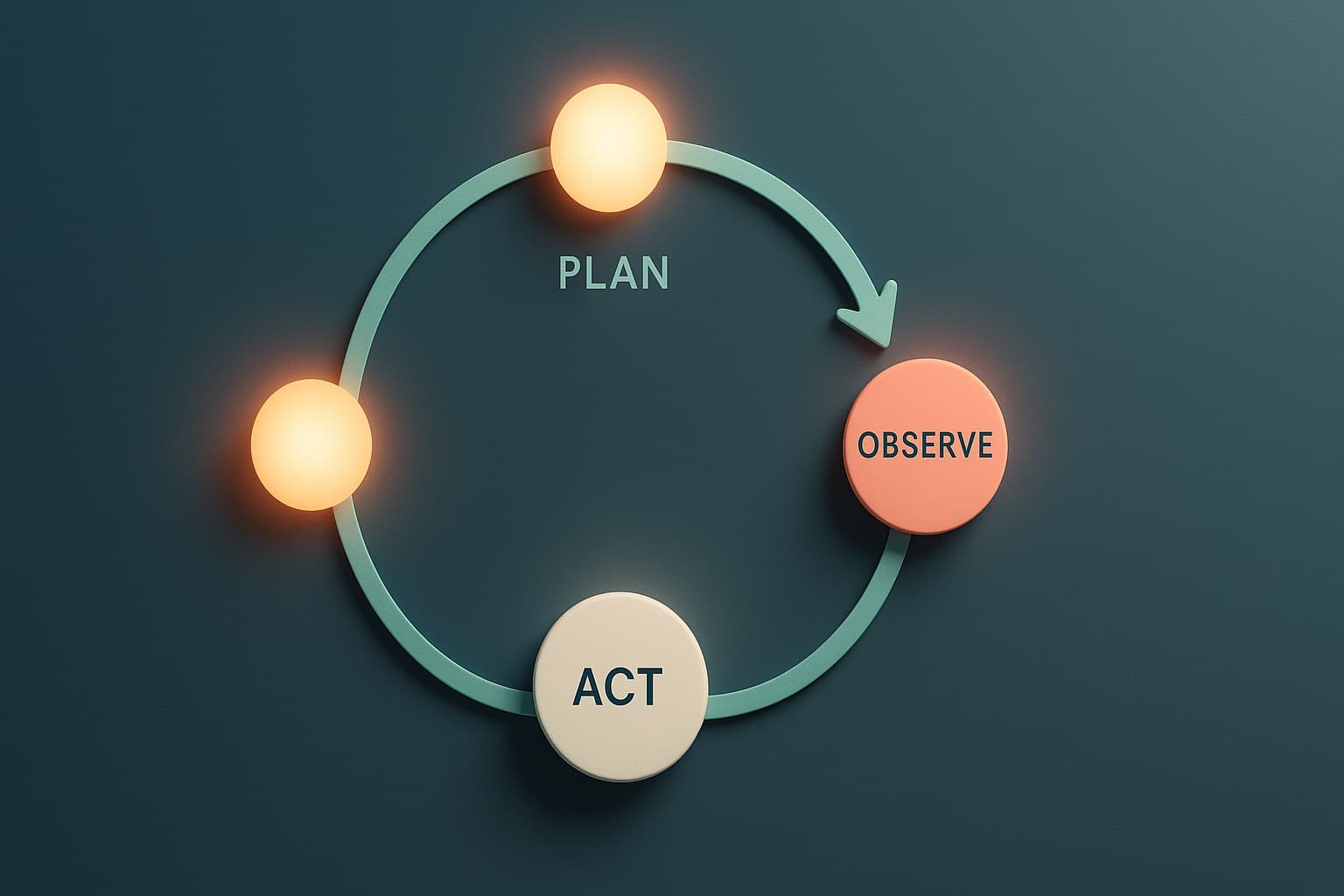
An agent, in the meaningful sense, is a system where a model plans an approach, calls tools and APIs to act on the world, observes the results, and adjusts over multiple steps towards a goal. The defining feature is the loop: it does not just produce one response, it works iteratively, deciding what to do next based on what just happened. That is what separates an agent from a single chat completion, however clever the answer.
A normal chat interaction is one turn: you ask, it answers, done. An agent is given an objective and then runs a cycle of plan, act, observe, repeat until the objective is met or it hits a limit. The model is still at the centre, but around it sits the machinery that lets it take action rather than only talk about it.
The shift from assisted to autonomous
For the last few years, most useful AI has been assistive: a co-pilot that makes a person faster while the person stays firmly in control. 2026 is the year the centre of gravity moves towards more autonomous agents that carry out whole tasks with lighter supervision. This is genuinely powerful, and it is also where expectations most often get ahead of reality, because autonomy raises the stakes of every mistake.
It helps to see this as a spectrum rather than a switch. On one end sits a tool that only suggests; on the other, a system that acts entirely unsupervised. Most good products in 2026 live somewhere in between, taking real action on the routine parts while keeping a person close for the rest. Where you sit on that spectrum should be a deliberate choice, matched to how costly a mistake would be.
What agents are genuinely good at
Agents earn their complexity on open-ended, multi-step work where the path is not known in advance and the right next step depends on what the last one revealed.
- Research and synthesis across many sources, where the trail cannot be scripted ahead of time.
- Tasks that require calling several tools in a sequence that varies case by case.
- Work where the system must react to intermediate results and change course mid-task.
In these situations, the agent's ability to plan and adapt is exactly what you want, because a rigid script could never anticipate every branch the work might take.
When a simple workflow is better
Just as often, an agent is the wrong tool. If a task is well defined and follows the same steps every time, a deterministic workflow is cheaper, faster, more reliable and far easier to reason about. Reaching for an agent there adds cost, latency and unpredictability in exchange for flexibility you do not need. The honest question is not could an agent do this, but does this task actually require an agent's judgement, or just reliable execution. A great deal of what gets labelled agentic would be better, and safer, as a plain automation.
There is a quiet cost to over-using agents that is easy to miss: every extra bit of autonomy is something more to test, monitor and reason about. A deterministic workflow does the same thing every time, which makes it predictable and cheap to trust. If you would be uncomfortable explaining why an agent made a particular choice, that is often a sign the task really wanted a workflow instead.
Autonomy raises the governance bar
The more a system can do on its own, the more it matters that you have designed how it is controlled. An agent that plans and acts over many steps needs scoped permissions, guardrails, human approval on high-stakes actions, and observability so you can see what it did and why. Autonomy without governance is not innovation, it is just risk you have not noticed yet. The teams getting real value from agents in 2026 are the ones pairing capability with control from the start.
This is also where most disappointment with agents comes from. A capable agent with no guardrails dazzles in a demo and then does something unacceptable in week three, and the conclusion drawn is that agents simply do not work. The truer lesson is that capability and control are two halves of the same build. The teams succeeding with agents just did not treat governance as optional.
A grounded way to think about it
Strip away the hype and agentic AI is simply a more capable tool with a narrower set of jobs it is genuinely best for. Use an agent when the work is open-ended and adaptive; use a workflow when it is repeatable and defined; and in both cases, design the controls before you turn it loose. Matching the tool to the problem, rather than to the trend, is what separates teams getting value from agents from teams getting headaches.
None of this is a reason to be cynical about agents. Used where they fit, they genuinely do things that were not previously possible. The point is only to choose them on purpose, for the problems that reward their flexibility, and to bring the same clear judgement to AI that you would to any other significant piece of engineering.
Knowing when a problem genuinely calls for an agent, when it calls for plain automation, and how to govern either safely, is exactly the judgement we bring to our AI agents work, so you adopt autonomy where it pays off and skip it where it only adds risk.
Relevant services
AI Agents & Assistants
Agents that do real work, reliably, not just in a demo.
Explore AI Agents →AI Pipelines & Workflow Automation
Automate the repetitive, error-prone work that slows you down.
Explore Automation →AI Consulting & Strategy
Turn AI from a buzzword into measurable business value.
Explore AI Consulting →