Automation
Connecting Your Systems: Integrations, Webhooks and MCP
By Niall · 7 min read
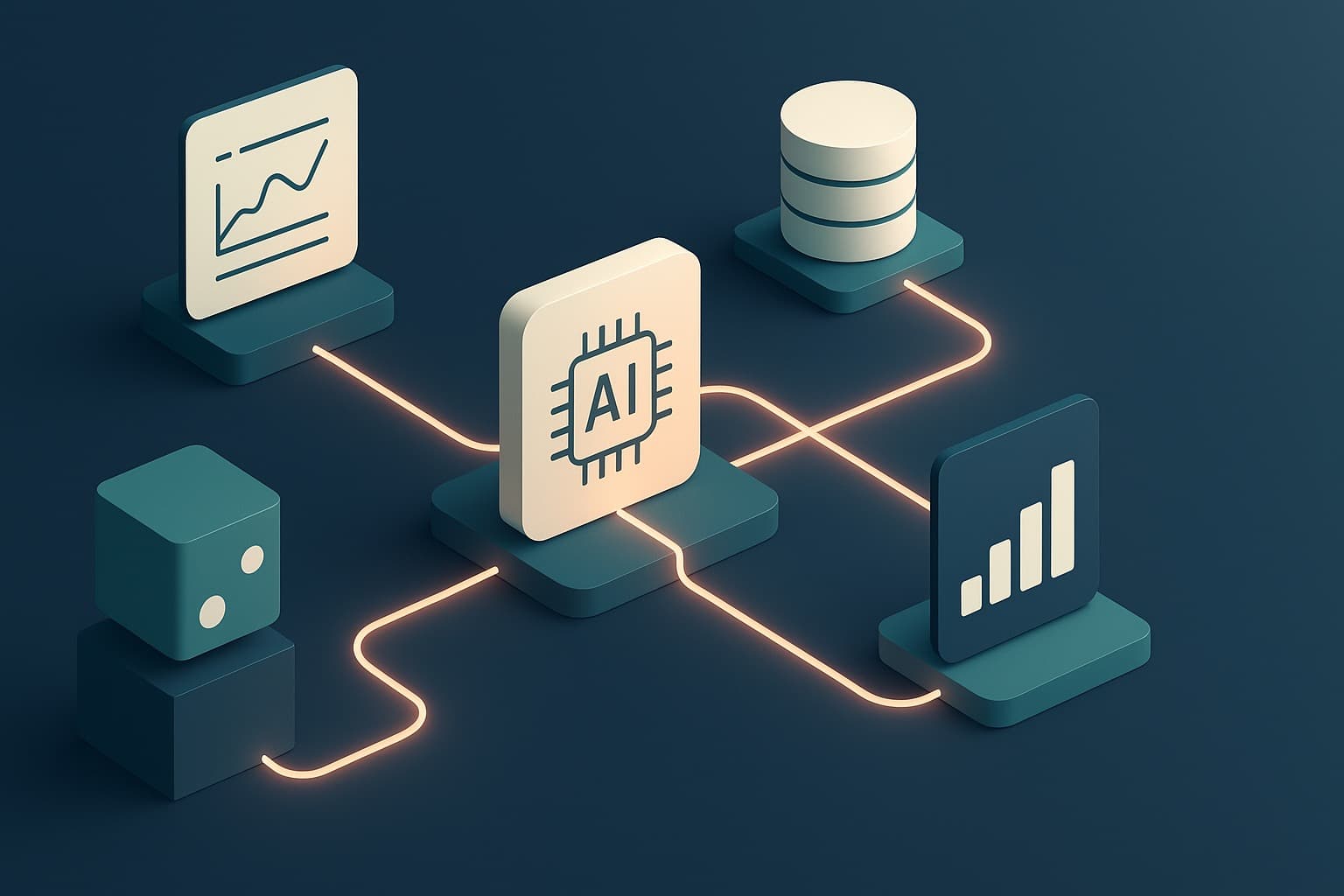
Getting your tools to talk to each other reliably is where the real value lives, and the reliability work is the actual job.
Most businesses do not run on one system. They run on a dozen: a CRM, an accounting tool, a help desk, a marketing platform, a database, and a handful of spreadsheets holding it all together. The value is rarely in any single tool. It is in getting them to talk to each other reliably, so that work flows without a person copying data between tabs.
Connecting systems sounds simple until you try to make it dependable. This piece walks through the main ways systems talk, where AI fits in through MCP, and the unglamorous reliability work that decides whether you end up with an integration you can trust or one that quietly drops data.
APIs: the front door to a system
Most modern tools expose an API, a defined way for other software to read and write their data. When you want to pull customers from your CRM or create an invoice in your accounting tool, you are almost always going through an API. They are the foundation everything else builds on, and they are the first thing to check when you weigh up a new tool. A good, well-documented API means it will play well with the rest of your stack.
Not all APIs are created equal, though. Some are clean, well-documented and stable; others are sparse, quirky or prone to changing without warning. Part of choosing a tool you will integrate with is judging the quality of its API, because you will be living with it for a long time, and a poor one turns every future change into a small ordeal.
Webhooks: letting systems tell you
APIs are something you call when you want data. Webhooks are the reverse: the system calls you the moment something happens. A payment succeeds, a form is submitted, a ticket is closed, and a webhook fires instantly so your workflow can react. The difference matters. Polling an API every few minutes to ask 'anything new yet?' is wasteful and slow; a webhook tells you straight away.
The catch is that webhooks arrive whether you are ready or not, sometimes more than once, and occasionally out of order. That reality shapes much of the reliability work later in this piece, so it is worth keeping in mind from the start rather than discovering it the hard way in production.
iPaaS versus custom integrations
When connecting two popular tools, an integration platform, often called iPaaS, can be the fastest route. Drag, drop, map a few fields, and you are live. For common, simple connections, that is frequently the right call and not worth building yourself.
Custom integrations earn their place when the logic gets specific, the volume gets high, or the connection is core to how your business runs. Off-the-shelf connectors tend to hit a ceiling: they cannot express your exact rules, or they get expensive at scale. The honest answer is usually a mix: buy the commodity connections, and build the ones that are genuinely yours.
MCP: giving AI safe access to your tools
A newer piece of the picture is MCP, the Model Context Protocol, a standard way to give AI models access to your tools and data. Instead of wiring a model into each system by hand, MCP gives it a consistent interface to the actions it is allowed to take, look up a record, create a ticket, query a database, within boundaries you define.
For anyone building AI agents, this matters. It turns 'the model can chat' into 'the model can do useful work in your systems', while keeping you firmly in control of exactly what it is permitted to touch. The access is deliberate and scoped, not a blank cheque, which is what makes it safe to put near real business data.
Reliability is the real work
Connecting two systems on a good day is easy. Keeping them connected on a bad day, when a service is down, a message arrives twice, or the network hiccups, is the actual engineering. A few principles separate dependable integrations from fragile ones.
- Idempotency: handle the same message arriving twice without creating two orders or two charges.
- Retries with backoff: when a system is briefly unavailable, retry sensibly instead of giving up or hammering it.
- Monitoring: know the integration is running and processing what it should, rather than just assuming it is.
- Alerting: be told the moment something breaks, instead of hearing about it from a customer.
The good news is that these are well-understood problems with well-understood solutions. You do not have to invent anything; you just have to decide that reliability is part of the job rather than an optional extra, and build it in from the start instead of bolting it on after the first outage.
Designing for change
Systems change. APIs get new versions, tools get replaced, requirements grow. Integrations built as a tangle of point-to-point hacks become a maintenance burden the moment anything moves. A little structure up front, clear boundaries, sensible logging, and a place to add the next connection, keeps the whole thing maintainable as your stack evolves.
It pays to keep a clear map of what is connected to what, as well. When an integration is one of twenty quietly running in the background, the hardest part of fixing a problem is often simply working out which connection is responsible. A little documentation and consistent naming save hours when something does eventually go wrong.
Well-connected systems are the quiet backbone of every good automation: data moves on its own, reliably, and your team stops being the integration. If your tools are not talking to each other the way they should, that is exactly the kind of plumbing our automation and engineering work is built to get right.
Relevant services
AI Pipelines & Workflow Automation
Automate the repetitive, error-prone work that slows you down.
Explore Automation →Custom Software Engineering
Senior engineering that ships, web, mobile, SaaS and APIs.
Explore Software →AI Agents & Assistants
Agents that do real work, reliably, not just in a demo.
Explore AI Agents →