Industry
AI for Professional Services: Reclaiming Hours From Paperwork
By Niall · 6 min read
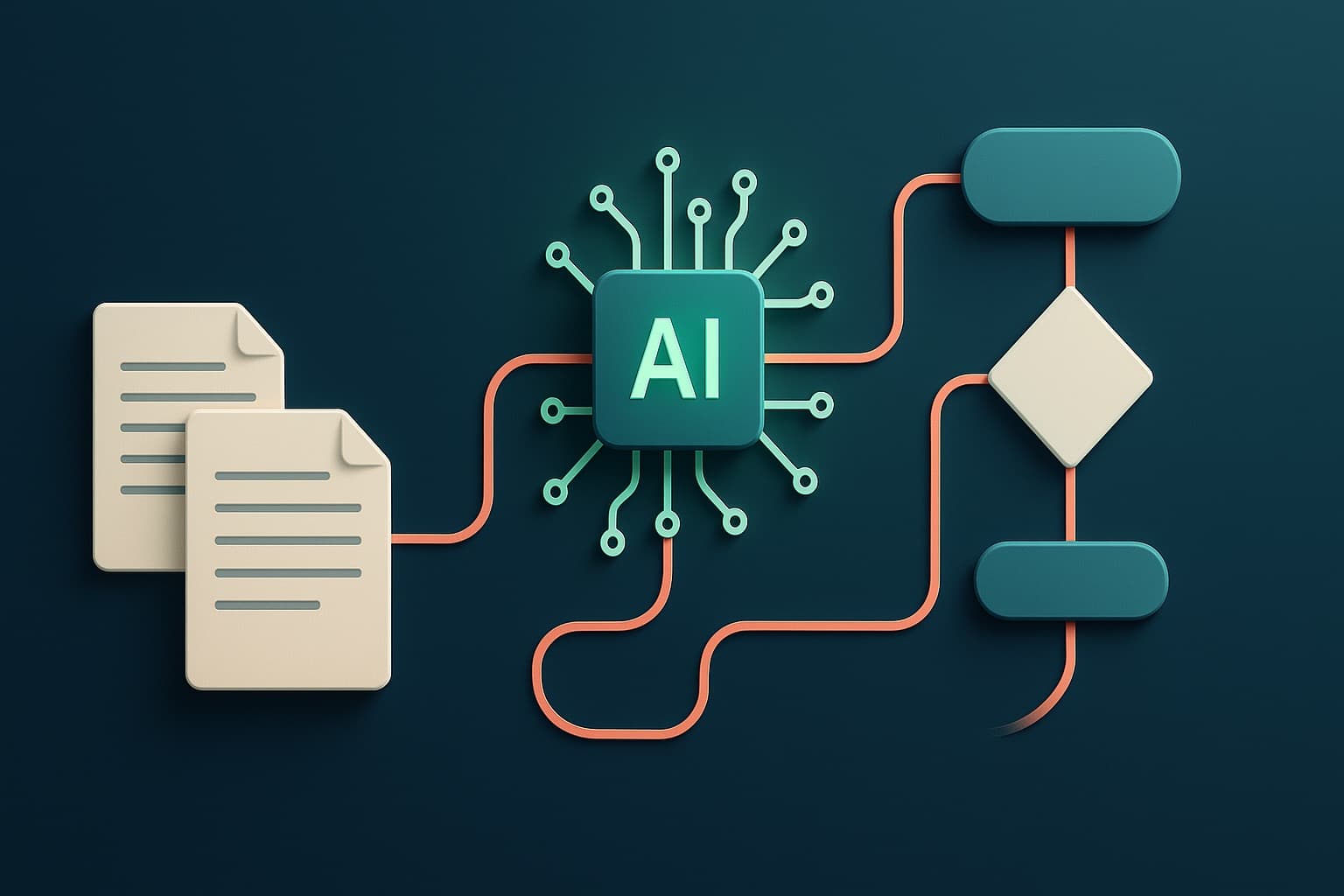
How professional services firms reclaim the hours lost to paperwork without ever putting accuracy at risk.
Professional services firms run on expertise, but a surprising share of the day disappears into paperwork: reading documents, re-keying data between systems, drafting routine correspondence, and answering the same internal questions over and over again. None of it is why clients hire you, and all of it eats hours your experts could spend on the work that actually carries their judgement.
AI is well suited to this kind of work, with one firm condition that we never relax: accuracy matters more than speed, and a human stays in the loop. Here is where professional services firms reclaim the most time without putting quality or reputation at risk.
Automate the document grind
Reading, extracting and routing information from documents is the classic time sink in professional services. Contracts, forms, statements, reports: work that is high in volume, heavy on rules, and genuinely mind-numbing to do by hand. AI pipelines can extract the structured data, flag the exceptions that need a human eye, and route everything to the right place, turning hours of manual reading into minutes of focused review.
The win here is not only time. Manual document handling is where small, costly errors creep in, because attention naturally fades over a long stack. A pipeline does not get tired on the fortieth document, and the exceptions it raises are usually the ones that genuinely deserved a second look.
Most firms are surprised by how much of this work is automatable once it is looked at squarely. The sheer volume is the very thing that makes it worth doing, and also the thing that makes people reluctant to stop and examine it in the first place.
Turn your knowledge base into an assistant
Firms accumulate enormous knowledge in documents, policies and past work, and most of it is effectively locked away in folders no one can search well. A grounded internal assistant lets your team ask questions in plain language and get answers drawn only from your real material, with the source attached so it can be checked. It cuts the time spent hunting for the right precedent or policy, and it answers from your facts rather than guessing at them.
The grounding is what makes it safe to trust in a setting where being wrong has real consequences. Because every answer points back to the document it came from, your people can verify in seconds rather than taking the assistant's word for it. It becomes a faster route to your own knowledge, not a replacement for the judgement of checking it.
Take the repetition out of rule-heavy workflows
Much of the back-office work in professional services follows clear, stable rules: if this, then that, route here, check against that list. That predictability is exactly what makes it a good candidate for automation. We map the workflow as it really happens, including the awkward parts, automate the predictable majority, and leave the genuine exceptions for a person to handle with full context.
- Intake and triage of incoming requests by type and urgency.
- Routine drafting from templates and structured inputs.
- Checks and reconciliations against defined rules.
- Status updates and routing between systems and people.
The mapping step matters more than it sounds. The official version of a process and the real one are rarely the same, and the gap between them is usually full of the small judgements that quietly keep things running. Capturing those honestly is what separates automation that holds up from automation that breaks during its first unusual week.
Keep a human in the loop where it counts
Professional services carry professional responsibility, so automation here is never a fire-and-forget affair. The pattern that works is straightforward: AI does the heavy lifting, a person reviews anything that carries real consequence, and the system is designed to make that review fast and easy. Clients still get the accountability they are paying for, and your team still gets the bulk of their hours back.
It also changes the nature of the work for the better. Instead of grinding through routine documents, your experts spend their time on the exceptions and the judgement calls, which is the work they trained for and the work clients value most. The drudgery goes, and the expertise stays.
Accuracy is the whole game
In this sector a confident wrong answer is far worse than a slow right one, because reputations are built on getting things right. That is why grounding, evaluation and review are not optional extras bolted on at the end, they are the foundation everything else sits on. We build these workflows to fail safely: when the system is unsure, it says so and asks a human, rather than guessing and quietly hoping that nobody checks.
Building for safe failure is a discipline, not an accident. It means deciding in advance what the system should do when it is unsure, testing it against the awkward cases rather than the easy ones, and measuring how often it gets things right before anyone is asked to rely on it.
Start with one painful process
The fastest way to see value is to pick a single document-heavy or repetitive process that everyone in the firm quietly dreads, and fix that one properly before touching anything else. The hours it frees up, and the trust it builds with a sceptical team, make the case for the next process far easier to make. Finding which of your processes will pay back fastest, then building them with the accuracy this work demands, is exactly what our AI consulting and automation work is built around.
Relevant services
AI Consulting & Strategy
Turn AI from a buzzword into measurable business value.
Explore AI Consulting →AI Pipelines & Workflow Automation
Automate the repetitive, error-prone work that slows you down.
Explore Automation →AI Chatbots
Chatbots people actually trust, grounded, scoped, helpful.
Explore AI Chatbots →